Wednesday, May 23, 2012

Shozo Shimamoto "Holes"

        Some of the earliest postwar performances took place in Japan. In 1954, an embodiment group was formed consisting of several Japanese artists who called themselves the Gutai. The name of this artistic group means to "pursue the possibilities of pure and creative activity with great energy." (Stockstad p.1087) Gutai held many performances and outdoor installations in front of the public where everyone could see how the group members created art. In these performances, it was the process of creating an artwork that was considered art, instead of calling the actual subject that was being created an "artwork".  One artist from the Gutai group whose artistic style stood out to me most was Shozo Shimamoto. "Shimamoto was one of fifteen young painters who were the original members of the Gutai Bijutsu Kyokai (Gutai Art Association), founded in 1954 under the leadership of the established painter Jirō Yoshihara" (Tate)

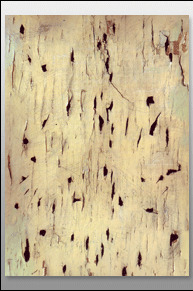
Hole (194 x 130.3 cm)        "Gutai focused on materials – both traditional art materials and more unorthodox ones, such as water, mud and chemicals – in a way that blurred the distinction between creative and destructive action. Artists sometimes performed ‘actions’ of an often very physical and violent nature." (Tate) During the second Gutai exhibition in 1956, Shimamoto performed Hurling Colors by smashing bottles of paint against a canvas that was suspended from a tree on the banks of the Ashiya River. To him, it was the performance of painting that was the artwork, rather than the subject produced. In a letter to Tate, the artist says what he feels, that his work transcends the violent nature of his techniques: ‘Even if my method seems shocking and violent – crushing bottles and shooting cannons at the canvas – because I am an artist my purpose is to make the work beautiful, to show the beauty of everything. I’m just working on creating beauty.’ (‘Breakthrough Performance’, p.42.)" Shimamoto has created many interesting paintings trough out his career as a Gutai artist. Another strange but interesting series of artworks of his is called Holes.
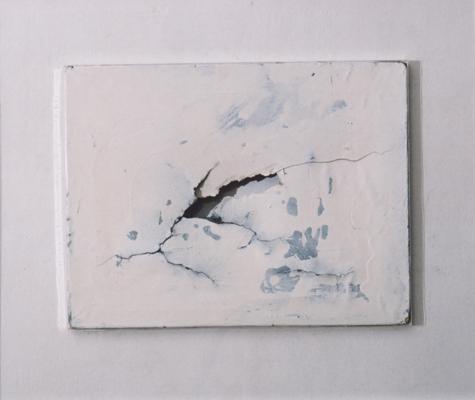


「瓶投げ 3」Shozo Shimamoto, ‘Holes’ 1953        The series Holes were created in the 1950s. Most of them were made about a year before the Gutai group was formed. "These works, like the various other experiments of the early Gutai, were not the result of a careful study, they were conceived almost by chance. At the time, in order to save money on materials, Shimamoto was using a screen of newspapers glued together instead of canvas, but one day he broke the surface by mistake.Instead of throwing away the work, he decided to show it to Jiro Yoshihara, who greatly appreciated it." (Shozo.net) Shimamoto added to these series of artwork by getting some silver paper and playing around with a hole punch in his studio in Japan. Then he decided to turn it into an artwork. "To make this work, foil sweet wrappers were perforated with a hole punch and pasted on a sheet of plywood painted black; a wash of black ink was then thinly wiped over the surface." (Tate) He has created many other artworks by piercing the surface of a canvas and adding different objects to them, such as paper and paint, to give the artwork a final look.

        Shozo Shimamoto's artworks takes avant-gardism to a whole new level. The results were often from the violent gestures and throwing of paint onto the canvas. This artist did artworks that were usually thrown away after the performance, because he believed that the performance and the process was the actual artwork. I really enjoyed reading about the Gutai group and the art of  Shozo Shimamoto.

http://www.shozo.net/works/indexe.html
http://articide.com.pagesperso-orange.fr/gutai/fr/ss.htm
http://www.tate.org.uk/art/artworks/shimamoto-holes-t07897

Wednesday, May 16, 2012

Dada and Surrealism Art

        Both, Dada and Surrealism artistic movements have changed the form, content, and concept of art. These "art movements sought both, to criticize artistic modernism and to realign avant-garde art with the practice of social life." (Challenge of A-G, p. 227) Dada artworks represented a collapse of the bourgeois cultural values and art that were called avant-garde up until 1915.  "Surrealism represents dissent from the restabilized bourgeois order in the 1920's and 1930's." (Challenge of A-G, p. 247) Both, Dada and Surrealism no longer concentrated on artistic form, aesthetics, and completion of expression.

        Surrealists studied acts of "Criminal Madness" and the "female mind" in particular, believing the later to be weaker and more irrational than the male mind." (Stockstad, p. 1057) They wanted to free the conscious mind from rational thinking and reason. That is why in their artworks we can see many techniques, such as automatism, which releases the mind from conscious control and produces a new juxtaposition of imagery and forms. One surrealist artist did this by placing paint on a canvas that has a rough surface beneath it. Then he would let the mind look at the result and imagine or fantasize the form on the canvas and then add more paint to turn those forms into an image and make it become more realistic. Surrealism artworks require the brain to wander off in order to complete what the eye sees, because just by looking at it, one will not be able to make sense of the painting.

        Dada mocked the senselessness of rational thought and even the foundations of modern society." (Stockstad, p. 1037) Marcel Duchamp created some of Dada's most complex works. He came up with the "readymate" Dada concept in which he transforms ordinary objects into works of art. Duchamp had argued with other artists that art objects are not only ones crafted by individuals, but that they could actually be objects that are mass-produced around the world. And he had proved this by creating many weird art works from ordinary, everyday objects, such as a porcelain urinal which he had named Fountain.  The Fountain is one of the most offensive artworks in Western History. It openly refers to the activities of the bathroom which include one of humanity's most humiliating functions and vulnerable states. Of course, just as Duchamp had anticipated, the Fountain was rejected from an art exhibition in New York. The artist had placed the object in a different position so that people will look at it from a different point of view and see a new artwork, which he had given a new name, but the people still saw an urinal and nothing else. They did not see it as an artwork that deserved to be shown in the gallery.

        I personally don't like how Marcel Duchamp had used the Fountain to show that art can be created from everyday objects. I can see how that particular object was offensive to the viewers and was rejected from being displayed in the gallery. But I do agree with the whole idea of Dada art in creating art from other ordinary objects that we can be found almost everywhere around the world. Even though they don't look appealing to me at all, I do think that Duchamp’s “readymades” should be called works of art at least because they were made by the hands of an artist. The person took time to recreate each ordinary object into something else with a new meaning so that people will look at it as something else and wander what else it could be used for besides it's original purpose.

Wednesday, May 2, 2012

The Yellow Christ

Paul Gauguin’s painting, "The Yellow Christ"  can be considered an “avant-garde” work of art. There are a few ways how this can be proven. I will use Griselda Pollock’s formula of reference, deference, and difference to prove my point. "Reference in an artwork shows an awareness of what was already going on. Deference is what defers to the latest and most radical developments. Finally, to be considered an avant-garde artist, one must establish a difference in their artworks that is legible in terms of current aesthetics and criticism and a definite advance on the current position. (Challenge of A-G, p 167)

             "The Yellow Christ" was painted in 1889 by Paul Gauguin. Some believe that the artist made this painting of Christ on the cross as a self-portrait.  This depiction of the male artist as a superior being is a way of showing that he is an independent and courageous artist, and yet, he is still struggling against the public that is not very accepting of the avant-garde art. This has been seen as a work of a modern male artist which critics and other artists have called avant-garde.                          


            "The Yellow Christ" painting is a "reference" to the Impressionist style. We can see how the artist ties in Impressionism in his painting to make it Post-Impressionist though the use of bright colorful figures with thick black outlines and  small, thin, brushstrokes. Also, the man running in the background is caught in the act of getting away, which represents the late 19th century desire to "get away" from the city life and get back to the "primitive", and much simpler life that was before. This depicted desire to "get away" is one of the big factors that makes a painting avant-garde.


           We can see how "deference" was used in "The Yellow Christ". It defers to the latest and most radical developments, in this case the artist defers to the use of symbolism and abstraction. First of all, the color of the Christ is obviously not natural, it is way too yellow. Also, the trees in the background have a form which is more geometric than it is natural. The people's faces are made with very little detail, and are also not realistic, which ads to the distortion of this whole piece. Even though the artist "derived this abstraction from nature, he dreamed before it and thought of the creation that will result." (Stockstad p.996) Another thing in "The Yellow Christ" that makes it avant-garde is how it represents the simple and primitive life of the peasants instead of the other paintings that depicted urban life and life of the upper class, and still makes it a "modern" art by showing the purity of the peasant style through the devotional poses of the women in the painting.

           The "difference" in the painting is the aesthetics of "Synthetic" and Subjective" art, and in this case, it is achieved through the use of "decorative" concept. The artist of the painting either exaggerated, distorted, or simplified the lines, colours, and forms to show a deeper meaning behind the painting. The people's faces are made with very little detail, are elongated, and are not realistic, which adds to the distortion of this whole piece. The form of the trees and the people is not natural and is very simplified. The lines are also very obvious and simplified through out the whole painting.


Wednesday, April 25, 2012

Gustave Caillebotte

Gustave Caillebotte was one of the Impressionist artists of the late 1800. His wealth allowed him to become one of the main financial backers of the Impressionists' in addition to participating in their exhibits. His style of painting, however, did not quite fit with the Impressionist style. Rather than painting in the formal Impressionist style of focusing on the effects of pigment and brushstroke, Caillebottes style included more of the modernity and new social forms of life in Paris. "The increased focus in subject matter and the conditions of modernity have enabled Caillebotte's work to become an area of critical attention once more." (Challenge of A-G p.138)

Caillebotte's style is both a celebration and a critique of modern life. It is a celebration because Caillebotte's family had an investment in rebuilding Paris during the reconstruction, and the artist had depicted this process in many of his paintings. By doing so, he shows celebration of the end of the siege and the beginning of a new modern city being rebuilt in the place of the old Paris. In his paintings he focuses mainly on depicting the streets of Paris, that have greater spaces but look isolated with few people in them, and paints them from interesting perspectives which create a modern look to them. He also seems to critique this new modern life that came to Paris which can be seen in the paintings that he made, depicting men doing women's work or chores around the house, and just being located in domestic places which are usually associated with females.

Some of Caillebotte's paintings are images of gender roles during the late nineteenth century. The
Luncheon, 1876, is one such painting in which we can see how Caillebotte showed this role play at his own home. This painting is set in a dining room. There is a table standing in the middle and it is covered with drinks and silverware. On one side of the table, Caillebotte's brother is starting to eat his meal. The interesting thing is that the mother is seated at the farthest end of the table, which looks even farther because of the elongated shape of the table, as a servant is holding a tray of food out to her. This distance between the sons and their mother shows how women were not treated equal as men and could not even sit near them in their own households. There is also an empty plate at the very front of the table, which represents the spot where Caillebotte himself is to be seated. "The representation of men within a domain more usually associated with women was clearly of interest for Caillebotte." (Challenge of A-G p.142) Along with other works by Caillebotte, this painting raised questions about the relationship between gender and domestic space.

Another thing that we can see in Caillebottes paintings that are associated with modernity is his depiction of the male nude. The interesting thing about it is the fact that not only is the setting of these figures contemporary, but also that it is a setting that is typically associated with the females, rather than the males. One such example of modernity can be seen in Caillebotte's painting Man at his Bath, 1884.(see image on the left) This painting depicts a male figure that is mostly nude, aside from the towel with which he is wiping his back. In one corner of the room we see part of a bathtub showing and a chair in another corner with some clothes on it. There is a light coming through the curtains which are covering the window in front of the man. The man is depicted from a rear view with his legs slightly apart, his feet planted squarely on the floor, and his head bent forward. The man is caught in action and the painting has a vigorous feeling to it rather than just a depiction of a passive bather. "Both, the pose and technique emphasize musculature, contained within a tightly structured composition." (Challenge of A-G p.150)  The stance of the figure and the method of painting make the painting distance itself from any reading of classicism.

Wednesday, April 18, 2012

"The Rue Montorgueil" vs "The Rue Mosnier with Flags"

"The Rue Montorgueil" and "The Rue Mosnier with Flags" are two very beautiful paintings that depict the French festival of June 30th, 1878. The Rue Montorgueil was painted by Claude Monet while The Rue Mosnier with Flags is an artwork created by Edouard Manet. Both of the paintings are made in the Impressionist style, which makes them similar to one another, but at the same time, we can see many differences between these two paintings that make them unique in their own way.

Claude Monet painted The Rue Montorgueil using oil on a 81 x 50.5cm canvas, in Paris, 1878. "The Rue Montorgueil unquestionably produces an effect of celebration and vitality; it asserts an equivalence between its own colouristic brightness and another kind of brightness it claims for the future." (Challenge of the A-G, p. 124) At first glance, the painting looks just like a blur of motion, which is very true to the Impressionist style of painting. But as we look at the painting for a longer period of time, we start to distinguish the buildings and the small figures of people in the streets below. The streets, he painted filled with people celebrating with raised hands. We can feel the motion and the business in this painting right away. The whole painting seems to be made up of the colors red, white and blue, which seem to be dancing across the canvas as Monet painted hundreds of flags being displayed and waved out of the buildings on each side of the street. Monet's painting is depicting not just any French festival, but an event that was organized to forget about what the Civil war had done to them and to rejoice with relief and pride for the prosperous future filled with stability. The scene in the painting is of people that don't want to remember the past, but are rather looking forward to a great life ahead.

The Rue Mosnier with Flags, was also made in 1878, but this one was painted by an avant-gardist artist Edouard Manet. The Rue Mosnier with Flags is a painting of the same French festival as Monet's The Rue Montorgueil, and it is also made in the Impressionist style. The same colors are used in this painting as in Monet's painting, but in Manet's painting, they are not as repetitive and are mostly in the background instead of covering the whole painting. Unlike Monet's painting, which introduces the festival from an aerial point of view, Manet's The Rue Mosnier with Flags gives us a view from the ground, and therefore focuses more on the people down below than on the flags and waving hands above. The fact that Edouard Manet was in Paris during the Prussian siege serving in the National Guard alongside Degas, played a huge role in the way in which he had depicted the celebration after the war ended. In The Rue Mosnier with Flags, we see the street as a large and empty space, "a blinding slice of light rather than a fluttering atmosphere". (Challenge of the A-G, p. 128) We can see some of the reconstruction going on as the roads are being rebuilt by working class men. The main thing in the painting though, is the back view of a crippled veteran walking towards the sunlit streets. This image creates tension and Manet leaves it to the viewer to decide what is at stake in this artwork.

While Monet was used to painting the triumphs of reconstruction in his country, Manet was more focused on capturing the event that lead the nation to this point in history. Monet painted a painting in which it is obvious that there is a celebrating event going on and the whole nation is rejoicing the end of the war. It is hard to see that in Manet'e painting of the same festival. He leaves a lot of detail out of his painting that tells us about what is going on. Instead, he just puts one very obvious figure in the painting, that tells us that there was a war somewhere, and the rest is unfinished as the viewer is forced to draw their own conclusion as to how this painting could be completed. It was very interesting to learn about how two artists of the same artistic period had captured the same event at the same time, but from a very different perspective.

Wednesday, April 11, 2012

Formal Analysis - "Sunrise"

Towards the end of the 19th century in France, many artists gathered together to create a new style of painting, the Impressionism style. Impressionist artists mainly focused on making their art based on the members of the upper middle class and their lives as they relaxed in the countryside. After having many successful exhibitions, the Impressionist were able to organize their own alternatives of the Salon and the Academics no longer had control over the artistic standards in France. Claude Monet is one of my favorite Impressionist artists. He was also a leading exponent in Impressionism. His artworks were of modern style that celebrated the pleasure of going out and enjoying the life in the suburbs. Most of Monet's early work included some kind of expanse of water. One such painting is called the "Sunrise". At first, the entire painting seems to be of one color, but at our eye adjust to it after a while, we can distinguish the details which are very distinct and beautiful.

My first reaction to the painting was peace and calmness. It made me a little bit lazy and I just wanted to go lay down and enjoy the "Sunrise". After looking at it for a while, I realized that the scene is not as calm as it appeared to me at first. Yes, the water has almost no movement, except in the proximate area of the painting, that is why the painting seemed calm at first. In some areas it is so still that we can see the sun and the trees reflecting in the water as if it were a mirror. But at the same time, when my eye went from the sun to the clouds and the rest of the sky, I noticed a lot more movement. The strokes that painted the clouds tend to be going in a circular motion causing them to look like they are in action. It also looks like there might be a storm brewing up somewhere out in the sea as the sun rises.

When he had finished his painting, Claude Monet's rough strokes and shifting forms looked like an unfinished product, which did not appeal to many critics and caused them to level against his painting. To a friend, Monet had said that "when you paint, you need to try and forget what objects you are painting, but instead focus on the colors and shapes that are before you." (Stockstad p. 986) The colors that were used to make the "Sunrise" are complementary and work really good in this painting. Since it is a water scene, there is a lot of blue in the paining. The sunset adds orange and yellow to the scene that makes it look very beautiful.

In the "Sunrise" we can see that instead of painting a bay area full of boats and a sunrise, Monet painted blue, orange, yellow, green and pink colors onto a canvas which resulted in a beautiful scene that we see in the final product. A circle of orange is what turned out to be the sun. Streaks of white, yellow, blue and orange, turned out to be the sky and clouds with color reflecting onto them from the rising sun. The vertical and horizontal lines of a deeper blue turned out to be the silhouettes of the boats and ships that are either docked or are out in the bay area. As we look down at the lower part of the painting, we see some splashes of green and sage that at first, look like lily pads on a pond, but in the end they actually turn out to be relatively smaller boats with people in them. There is also a glistening blue color that makes up the water and the dashes of green represent the waves that are making their way to a tan colored dock, which also seems to be dissolving in the blue water scene. The water has other colors that reflect in it from the clouds and the sun, the most evident one is the reflection of the sun which stretches out vertically across a large portion of the painting.

The "Sunrise" gives you a sense of calmness after a storm had passed through, or even the kind of calm that is right before the storm hits. The whole composition, aside from the sun and the bold figures on the boats that are in the center of the painting, looks ghostly and washed out. It takes a while for your eyes to adjust to the painting and be able to make out what is actually going on in this painting. When you paint all of the mentioned above colors, shapes, and lines in the places that your eye sees them, you get a whole new impression on what is in front of you. Rather than looking at the scene as one whole, you will now see it as many colors, shapes and lines arranged in a particular order to make up a beautiful composition.

Wednesday, April 4, 2012

A Burial at Ornans


19th-century France had many political and social issues going on that were contradicting with the artists works at that time. Realism was the new style that had emerged into the French art world. One artists paintings were especially offensive to the bourgeoisie. Gustave Courbet's paintings embodied historic events that were captured in vivid realism. One of his paintings, which had made him one of the most famous 19th century artists in France, is called A Burial at Ornans. The harsh realism of this artwork is what offended the bourgeoisie.

A Burial at Ornans was made around 1850, in France. This painting is like a memorial the funeral of Gustave Courbet's great-uncle which was held in September of 1848 in a small town of Ornansin, the birth place of the artist. An ordinary rural funeral had been captured in this painting with unbelievable realism. During those times, making a painting of a funeral or a similar event was traditionally reserved for heroes or religious people from the history. That is why many people were offended that an unheard-of-before great-uncle was given such honor and fame to his death through Courbet's painting. 

I don't agree with the viewpoints that the bourgeoisie had on artworks during the 19th century. A Burial at Ornans is a very beautifully composed painting that acknowledges the importance of dignity in the life and death of an ordinary person. Grievers surround the open grave, which is at the center front of the painting, alongside a priest, a gravedigger, friends and family who are mourning the deceased. The grouping of mourners and attendants is not random, but rather stays in line with the horizon, forming an "S" shape, so that not one persons head draws up into the sky. In the background, the only thing, aside from the landscape and nature, that extends into the sky is a cross with the crucified body of Christ that is held by a religious attendant. The colors of the painting are very dim and monochromatic, which match the mood of the event and the faces of the grievers, who are captured in great detail. The only bright color in the painting could be seen in the white dog that is standing above the grave, looking back at the grieving women, and in the clothes of the holy men standing behind the priest. There are two men dressed in red, which I assume are guards, that also stand out from the monochromatic setting of the funeral and crowd of mourners. Also, the earthbound nature of life is indicated by framing the figures in the painting with dirt and rocks. Everything in this painting is arranged perfectly to match the mood of the event and to honor the life of an ordinary man.

I really enjoyed the Realism that can be seen in Gustave Courbet’s painting, A Burial at Ornans. The painting honors a life of an ordinary human being that was not of royal blood or a religious figure. He was a simple every day man, just like most of us. I am glad that finally some artists came up and decided to change up the rules a little bit about painting only prestige life and famous historical events, and added Realism to their paintings.